“Can you make a truly natural hair colour at Krya?”
It was 2016. The Krya factory had been operational for a year and a half, and we had started expanding our hair and skin portfolio, one product at a time.
Then a customer wrote to me asking me what would end up being a life-changing question: “Can you make us a natural hair color?”
I didn’t have an answer right away. So when Srini and I worked on the blueprint of what would end up being the Krya universe, I had put in hair care and skin care. But I had deliberately veered away from colour cosmetics or hair colours.
But now that I was evaluating hair colour from a fresh perspective, I realized that this category behaved very close to hair care. Unlike makeup or cosmetics, hair colour had become almost ubiquitous. If you had a visible amount of grey or were of a certain age, you “had” to colour or dye your hair. Not dyeing was simply not an option.

And because of higher stress and poorer hair care, most of us were graying much faster than our earlier generations. So aging gracefully when you were a 30-year-old didn’t make sense.
I looked around at what already existed in the market and realized nobody had actually solved this problem, at least not honestly.
What the Hair colour Market Pretended Was Solved
In 2016, natural hair colouring was still small. But it was slowly picking up thanks to information slowly surfacing on the side effects of Ammonia , Peroxide and PPD, very strong reported adverse reactions, and greater hair damage. The thing is, earlier hair dyes were used by senior citizens — so when they reported hair loss, it was dismissed as a part of natural aging. No one really probed the effect of hair colour and dye on this.
But with hair dyes and colours being increasingly used by younger and younger people, the scrutiny started becoming more intense. But what was the market response?
There were brands calling themselves “less harmful,” or “organic” simply because they’d removed ammonia, while swapping in other harsh chemicals like resorcinol instead. There were brands that outright mislabeled themselves, henna and indigo or henna-based colours with PPD, marketed as “natural” when they weren’t.

And then there were the genuinely honest brands, the ones selling pure henna and pure indigo. But that’s all they gave you: the raw herb, sold separately.
People had, in fact, been layering pure henna and pure indigo as two separate steps for years — that part wasn’t new. What was missing was a proper blend: complementary Ayurvedic herbs formulated together with each dye, guidance on how to actually maintain the color, and a real support system to keep hair healthy through the process. Customers were left to figure all of that out alone.
“This time , its personal” – or Why This Category Mattered to Me
This category matters to me at a personal level. Because I had interacted with these products as a user, and as a formulator, could read the chemistry behind the claims.
My mother started greying extremely early. She had and continues to have serious vision issues, and she dyed her hair right from her 30s. In hindsight I wonder if her persistent hair dye use actually aggravated her existing vision issue. The adverse effects I read about seem to suggest that they did.

With my Parents on vacation – Both had started hair dyeing for a few years by this time 🙁
My dad experienced fewer issues because he started dyeing his hair in his 50s. Again he went bald quite rapidly — but then all of us put that down to existing genetic hair thinning and didn’t see a trigger.
I saw my parents’ friends and other older family members experience more visible effects of hair dye. The women faced severe and rapid hair loss and hair thinning. Many of them developed severe hyperpigmentation on the scalp, forehead, and sometimes on the nape of the neck, with visible changes in skin texture.
Nine years ago, when I started working on our hair colour range, I threw out all the boxes of hair dye my mom was using.
To my pleasant surprise, I saw that her hair, which had thinned down considerably, actually improved visibly in growth and thickness over time. She still grew out silver hair, but its quality and texture was much better than what she had when she dyed her hair.

The Perils of PPD
PPD is dangerous both in its raw form and when it oxidizes on your scalp. In an alkaline environment, PPD is oxidised by hydrogen peroxide into a reactive quinone-diimine intermediate, which then couples with agents like resorcinol to form large, conjugated dye molecules that lodge permanently inside the hair shaft. That coupling reaction is what gives chemical dye its color permanence — and it’s also exactly what makes it a sensitizer.
Unreacted PPD and resorcinol have been measured remaining in the hair and on the scalp even after the dyeing process is “complete,” meaning exposure doesn’t end when you rinse. Separate laboratory studies have shown that PPD, on its own and in combination with hydrogen peroxide, generates reactive oxygen species and hydroxyl radicals in human skin cells strong enough to cause measurable DNA damage.
In fact, PPD was significant enough as an allergen that the American Contact Dermatitis Society named it “Allergen of the Year” in 2006! And in Indian dermatology patients specifically, PPD patch-test positivity has been recorded as high as 11.5%, among the highest reported anywhere in the world, with sensitization rates rising roughly fourfold over a single decade in Indian clinical cohorts.
This is a chemical reaction happening on living tissue, and nobody in the industry seemed to be treating it with the seriousness that consumer safety actually demanded.
My lived experiences with this category, the actual harm being caused by this category, and its ubiquitousness in a consumer’s life pushed me to a single thought — we had to launch an alternative.
Fifty-Four Formulations & supplier visits
I started working on this category with one special appointee from Production who would record the experiments and keep track of each formulation.
We sourced actual human hair, untreated and uncolored, and divided it into bundles. Over that year we went through a huge number of bundles as we experimented with single herbs, herb blends, and then semi-finished formulations.
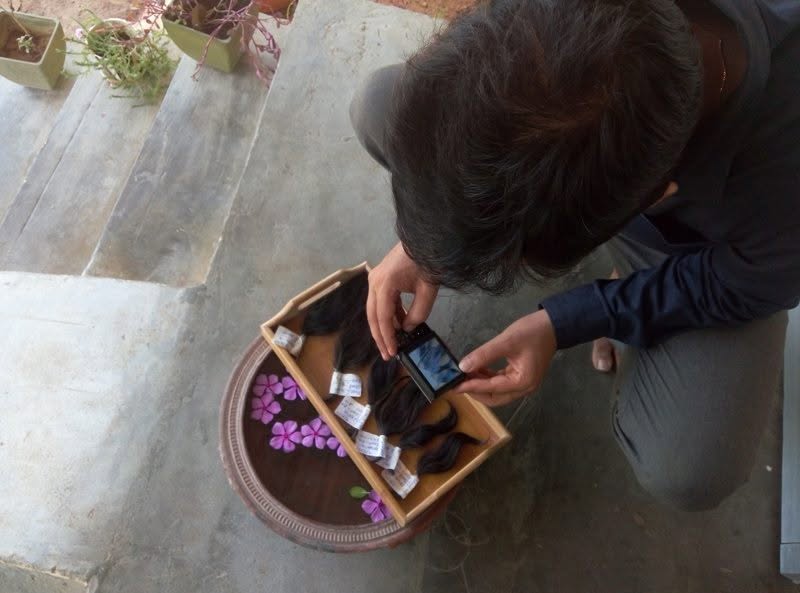
Recording hair swatches and their colour uptake
Simultaneously I started to visit and qualify herb suppliers. Distressingly many of the herb suppliers I spoke to, especially those selling Indigo, openly and freely admitted to adding PPD into their prepared Indigo colour to give a quicker and more stable colour.
So while we worked on the formulation, I was also simultaneously working on the process. Apart from one or two brands, the majority of brands selling natural hair color did not process the raw herbs themselves. They bought semi-finished herb powder and either did a sift at their factory or merely prepacked the product. And unless they tested every single batch for PPD contamination, they could not be sure if their prepared powders were actually pure.
I decided to start with single-step hair colors, because that’s where the market’s most immediate need was — and because I wanted to prove, first, that we could build something entirely PPD-free, resorcinol-free, ammonia-free, that actually worked at the level of real, durable color, not a product that fades in two washes.
What the First Krya hair colour Launch Taught Us
Over one year, we worked on 54 formulations one by one. We carefully labeled and stored hair bunches, which showed us how each formula looked on human hair. Every time we got a decent batch with good colour, we sent them to our human volunteers.
And that was the third part of working on this category. We identified a set of human volunteers from the Krya community in different age bands, different hair types, and living in different cities. Because the quality of water, hair type, and all could slightly alter the productivity of our coloring herbs, we collected data on all these factors so we could advise our customers better when we finally launched.
At the end of one year and 54 formulations, we found the three that felt right: Truffle Brown, Midnight Black, and Natural Black.
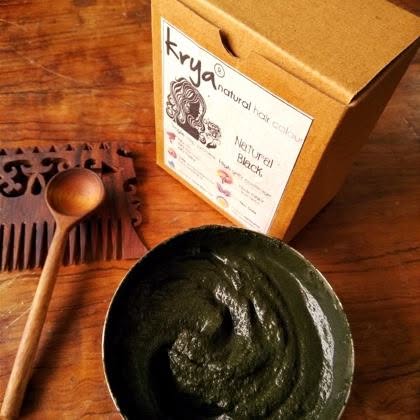
The Krya Natural Black formula – taken soon after launch
We also tested out our competition on human hair, and developed a spidey sense of their formulations. We could only work with the information they presented, of course. But our extensive work developing our own formulations, identifying the correct herb suppliers, and testing them on consumers gave us an idea of what was going on with competition.
Many brands which marketed themselves as natural gave us completely different results from using pure herbs. The colour, speed of color appearance, and slow fade gave us an indication of PPD contamination.
We finally launched our colours in 2017.
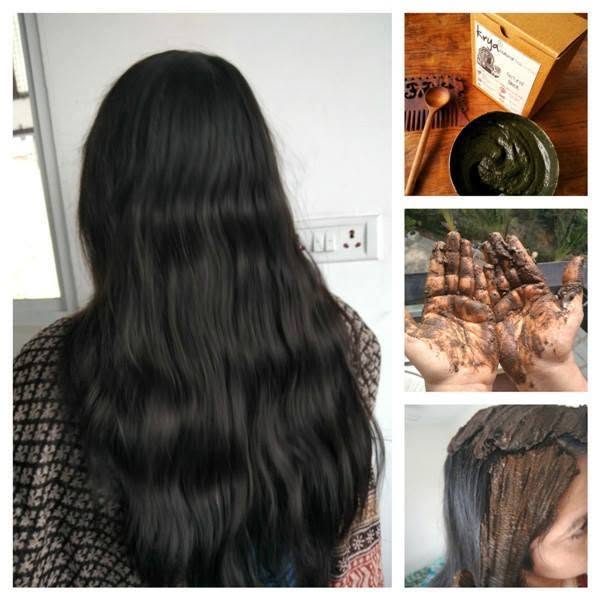
Me trying the natural black formula soon after development
Looking back today, what surprises even me is that the core formula for those three shades has barely changed since — years later, it’s still holding, which tells me we got the underlying chemistry right early, not that we got lucky.
The Krya hair colour launch in 2017 was just the beginning
Launching was just the beginning of our hair colour story: it was the start of an education process. Customers coming from conventional hair dye had certain expectations baked in: thirty minutes, done, walk away. That expectation comes directly from the oxidative coupling chemistry I described above.
It’s fast because it’s forcing a permanent chemical bond inside the hair shaft using peroxide and an alkaline agent.
The chemistry of natural colours is completely different. Lawsone, the active pigment in henna, binds to keratin through a Michael addition and deposits externally on the hair shaft rather than penetrating and reacting inside it.
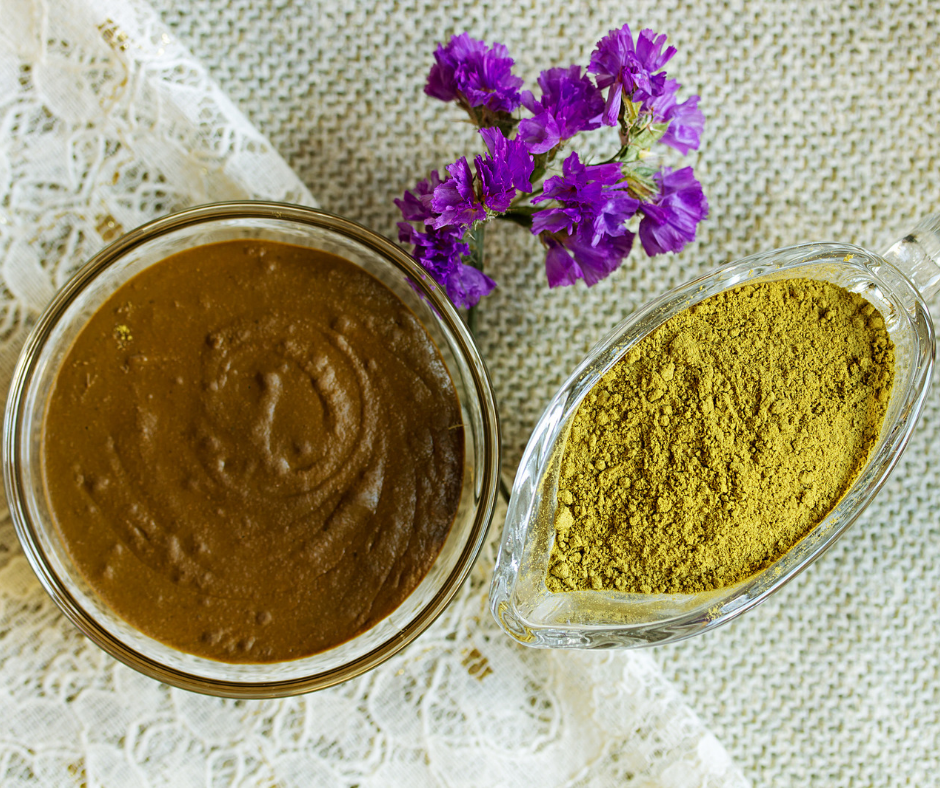
The Chemistry of Natural colours is completely different
Because it coats on the surface, a natural hair colour is vulnerable to everything that affects your hair strand: like heat, harsh shampoos, rough brushing. Pretty much anything that damages your hair also damages your natural hair colour because the color is deposited onto the hair strand.
That meant real time, real aftercare, and a real education curve for customers used to synthetic speed. Despite that learning curve, the fact that we were genuinely, provably natural — and that we stayed present to support customers through the adjustment — helped the business grow steadily.
Natural hair colour performance issues on dye resistant greys
A few months after launch, I started noticing another pattern. Our single-step colours worked very well for many customers. But customers with very high percentages of gray hair were seeing faster fade and weaker color latch — they needed to reapply far more often than others. And for people with especially thick, coarse hair, the gray strands themselves were sometimes outright dye-resistant; the color simply wouldn’t take properly.
I first started by doing higher process improvements. Indigo needed to be processed at the correct particle size to release the dye molecule. It was famously finicky in that any exposure to moisture, etc., meant that dye release would be inconsistent. And it needed to be mixed and applied quickly, because dye release happened in under 20 minutes.
So we worked on two fronts: improving our ability to process indigo internally and giving customers the most precise instructions to get the best out of dye. We also found that Indigo had shade variations depending upon where we sourced it. After many trials we qualified our supplier and we buy only from that one supplier for the last 9 years.
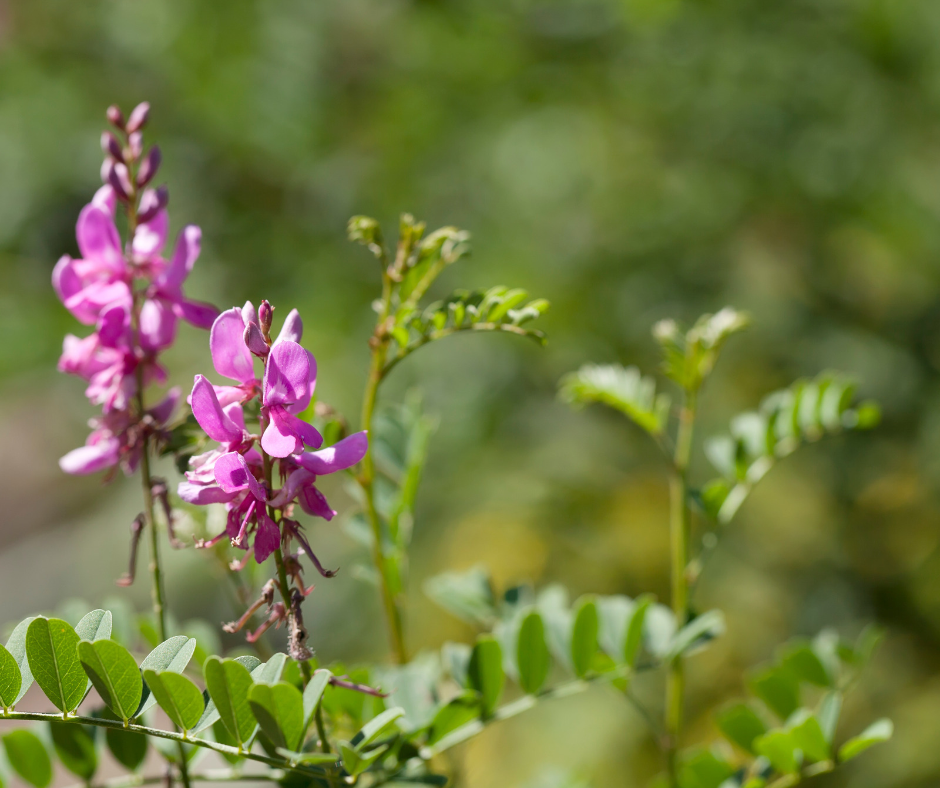
We continue to source Indigo and Henna from a single supplier (each) – we qualified both at launch
Despite all these improvements we found that people with high greys got a colour which lasted less time. This told us something important.
Coarse, gray hair has a different cuticle structure and different surface chemistry than pigmented hair, which changes how any external dye molecule can adhere to it. We needed an entirely different system — not a tweak, but a structural rethink — for people with heavy graying and dye resistance.
The Two-Step Natural Hair colour Idea for Better coverage & dye resistant greys
I had come across the idea of two step process before. This was not something we invented. In fact Indigo and Henna had become very famous in the African American community as an alternative to hair dye.
African Americans had extremely thick and curly hair. And it was also severely damaged because they used relaxers and straighteners from a very young age. So because of high hair porosity and hair damage, they had adopted Ayurvedic hair care at least 20–30 years before any of us in India actually did.
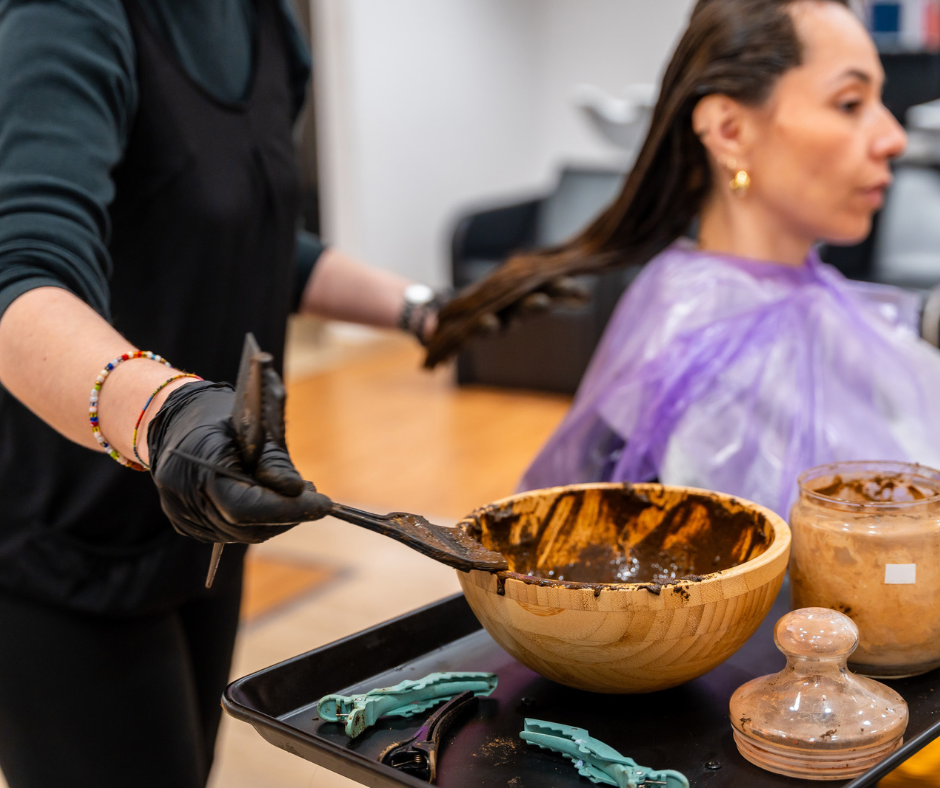
Henna has been used by the African american community for many years now (much before India really took to instead of synthetic dyes)
Because the hair colour resembled Indian hair colour, they had figured out the two-step process and there were many brands catering to this market there. But what didn’t exist was this:
- A thoughtfully formulated two-step system that used other herbs outside of pure henna and indigo.
- Designed to work together as a single coherent system rather than two raw, unsupported herbs applied back-to-back.
The 2 step Chemistry Problem
We started experimenting with our own version of a two-step system. For example we found that if you layered Truffle Brown followed by Midnight Black, the colour you got was much deeper and longer lasting.
A pure henna blend followed by pure Indigo tended to sometimes make hair dry and stiff. So it delivered on colour but not care.
On the other hand, when we made a specific Henna blend with other herbs that provided Henna the pH it needed to work and followed it up with a special Indigo blend with other complementary herbs, the results were better. The final product worked well both on colour, scalp care, and actually improved hair over time.
This correlates directly with product chemistry and Ayurvedic research.
The documented chemistry of these two herbs explains why we get a tighter colour latch and more long lasting colour with this two-step process. Indigo, in its reduced leuco form, cannot bond to hair on its own — it requires the lawsone already deposited by henna to act as a bonding substrate before it can oxidize back to its colored, insoluble form on the fiber.
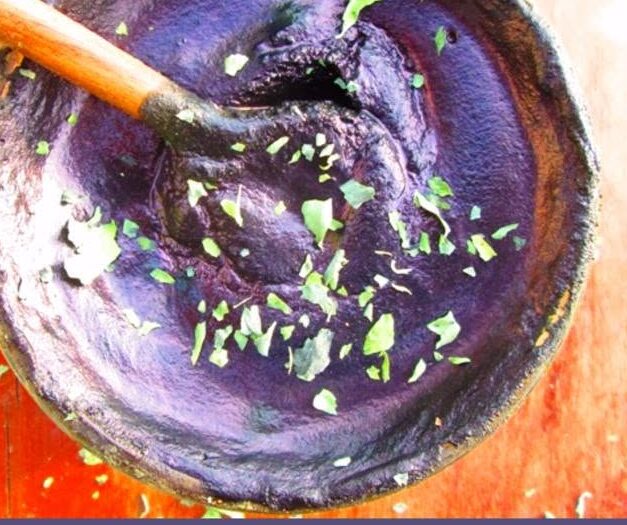
The Indigo bloom in action. On hair it bonds better onto Henna
Lawsone itself deposits onto keratin through what is called a Michael-type addition — a nucleophilic addition of amino groups in keratin onto the electrophilic naphthoquinone structure of lawsone, forming a stable covalent linkage to the protein. Henna doesn’t just “sit” on hair, it reacts with it, in a controlled, non-toxic conjugate addition.
Indigo then deposits on top through oxidative polymerization once exposed to air, re-forming its insoluble indigotin structure directly onto that henna-primed surface.
Here’s where the real formulation struggle began. Henna’s Michael-type addition onto keratin proceeds efficiently in a mildly acidic environment — which is why we support it with herbs like amla, haritaki, and bibhitaki, all of which naturally hold the mixture in that acidic range.
Indigo, by contrast, needs an alkaline environment to fully reduce and then re-oxidize efficiently onto the fiber. This is ok when we try to dye fabric with indigo. But absolutely not good for human hair. An alkaline environment disrupts the hair’s cuticle and damages the scalp barrier health. This was a compromise I was not willing to make just to get better color deposition.
Building the Krya Dwii 2 step hair colour
This is a well-documented tension in natural dye formulation — henna and indigo pull in opposite pH directions, and most formulations either force an alkaline shift or accept weaker indigo performance. Instead, we spent a focused stretch of R&D searching for complementary herbs that could help indigo perform at its best without ever pushing the formula into alkaline territory.
From an Ayurvedic point of view, we leaned heavily on the properties of Henna and Indigo and found the correct ayurvedic herbs that support their action. So henna was strengthened by the addition of intelligent acidic pH herbs like Amla, and haritaki.
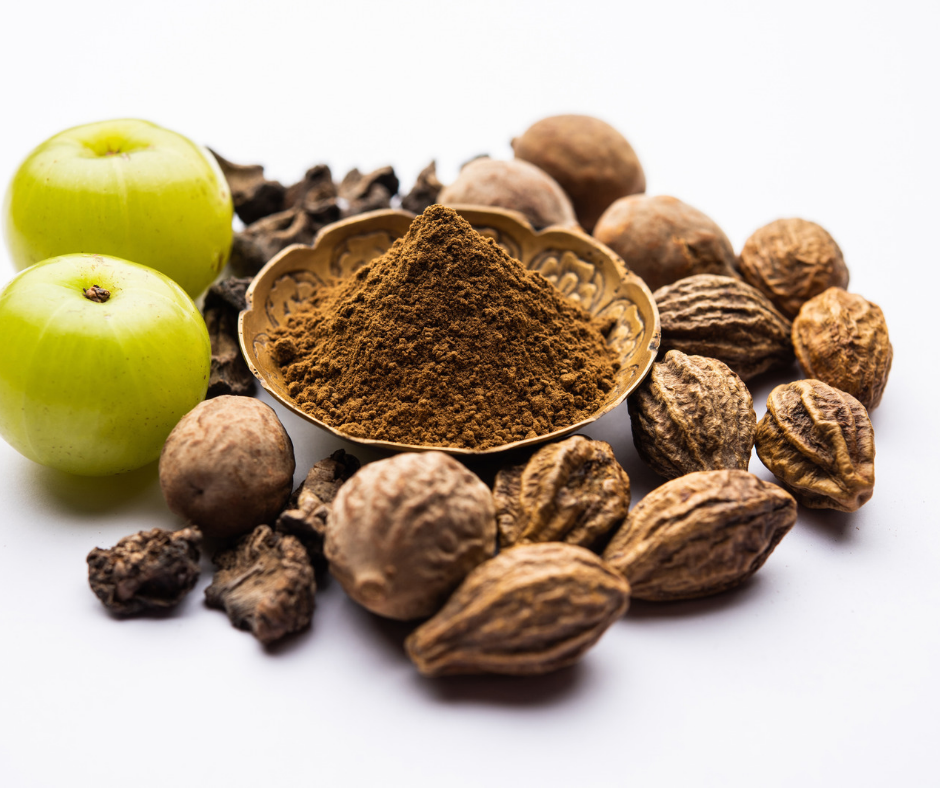
Herbs like Amla & Haritaki strengthen the Henna-Hair bond
Indigo’s drying action was tempered by the use of carefully chosen colours which would not just add to Indigo’s hair darkening but which would also counters Indigo’s drying and sometimes irritating action on the scalp.
Our contribution wasn’t just in enlarging the idea of a two-step concept. It was deeply understanding colour and hair chemistry, and building a real, supported blend for each step, sequenced deliberately around this exact reaction chemistry, plus the aftercare system around it.
Once we had a version we believed in, we started another round of testing. We tested it directly with our existing single-step customers — specifically those with higher gray percentages and documented dye resistance — and paired it with additional hydration support. That process, moving quickly on the back of what we’d learned from the single-step launch, became our two-step “Dwii” formula, which we brought to market in 2018 , one year after our single-step colors.
Building a category takes time (patience is key!)
When we finally brought the two-step system to market in 2018, we made a deliberate choice to launch only in black, even though brown and additional black shades were already on our roadmap. Perfecting one shade’s reaction chemistry at real scale mattered more to me than rushing three shades that weren’t fully proven.
The timing mattered too. Even in 2017–18, most people still didn’t fully understand what a “30-minute” chemical hair dye’s oxidative coupling reaction could actually do to their body, not just their hair.
Awareness has grown substantially since then, and the clinical data backs that shift: dermatology literature over the last several years shows a sustained, well-documented increase in hair-dye-related contact dermatitis presentations. At the same time, people are graying earlier in life than previous generations did, which means more cumulative exposure to oxidative dye chemistry across a lifetime, and correspondingly more sensitization risk.
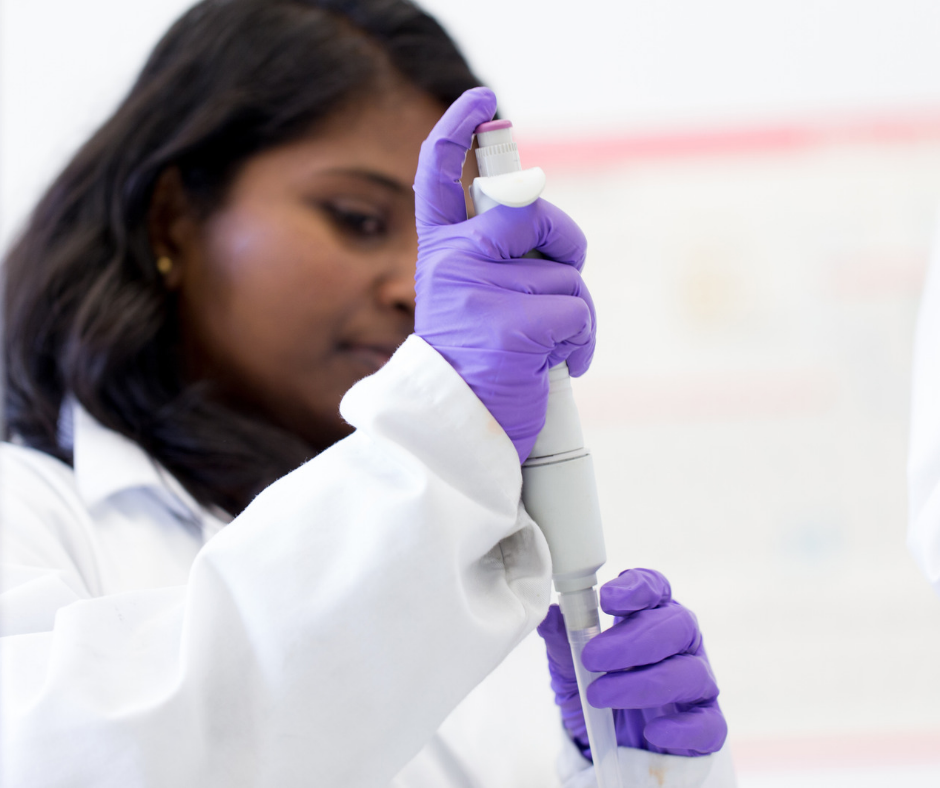
Research tells us that Indians are increasingly experiencing more and more dye related sensitization
All of this converged into a stronger, more informed demand for what we were building.
Any natural hair color takes time — a single-step application runs about two hours for lawsone to fully bind to keratin, plus aftercare. A two-step color effectively doubles that commitment: Stage 1 for two hours to let the Michael addition complete, a day’s gap, then Stage 2 for indigo’s oxidative deposition, plus its own aftercare. It’s a real ask of a customer’s time.
But I’ve come to see that time requirement as one of the strongest proofs of what we’re doing. A slow conjugate addition reaction, at room temperature, without peroxide or ammonia forcing the pace, is simply what real, non-toxic chemistry looks like.
Most importantly the Ayurvedic science behind each of the two steps gives us a colour that doesn’t just cover greys. We have had consistent feedback from consumers who have used our colours from launch on the improvement in scalp and hair health over time, thanks to these beautiful herbs.
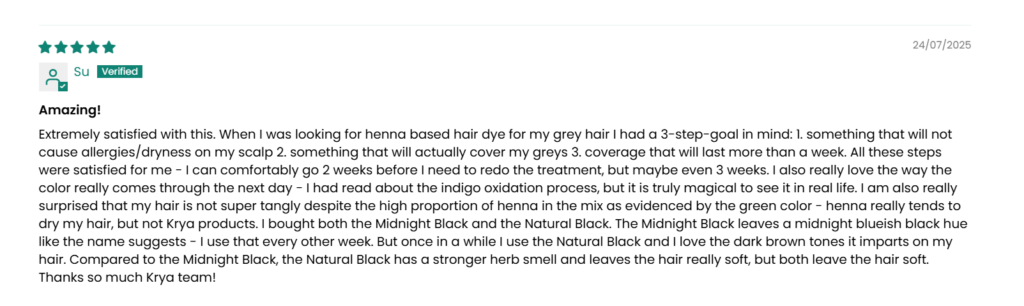
For the group we specifically formulated this product for: (higher or more dye resistant greys), the 2 step formula gives them stronger coverage, more solid color bonding, and results that hold.
Because of the time commitment, our two-step line will probably always be a smaller product line than our single-step colors, and I am okay with that. It has an intensely loyal customer base precisely because it was built to solve a real, specific, previously unsolved problem.
Our continuing journey at Krya
It’s easy to tell people what not to do — don’t use PPD, don’t use ammonia, don’t use resorcinol. It’s much harder, and much more valuable, to give people a real alternative that actually works, especially when not everyone wants to go gray or go fully natural in every part of their routine.
What I love most about our hair colors — both single-step and two-step — is that they were never designed to just deposit pigment. Like any properly formulated Ayurvedic product, they carry additional benefits that customers notice and talk about.
Read through our reviews and you won’t just see “the color turned out great.” You’ll see people talking about healthier scalps, better hair growth, hair that genuinely feels better. That is not language anyone associates with a conventional chemical hair dye, because oxidative coupling chemistry was never built to support your hair. It was built to change its appearance permanently, at real cost to the hair and scalp underneath.
A brand / enterprise is built through the lived experiences of its founders. Every strongly held belief I had in the virtue and power of herbs, nature , coupled with my distress at seeing the FMCG industry from the inside, led me to build Krya.

A brand is built by the lived experiences of its founders.
Today, looking back, I am happy to continue to build Krya and am especially proud of the hair colour range we have built. I hope our hair colour range offers another Preethi somewhere, an actual alternative to convince her parents to stop using a PPD based synthetic hair dye.
This blog reflects my own experience building this category in India.
Sources
- Yildirim, S., et al. (2022). Oxidative coupling mechanism of p-phenylenediamine (PPD) and couplers in oxidative hair dyes.
- Rastogi, S.C., et al. (2006). Unconsumed precursors and couplers after formation of oxidative hair dyes. Contact Dermatitis.
- Zanoni, T.B., et al. (2015). The oxidation of p-phenylenediamine, an ingredient used for hair dyeing purposes, generates ROS and DNA damage in human keratinocytes. Toxicology.
- American Contact Dermatitis Society, Allergen of the Year designation for p-phenylenediamine.
- Gupta, M., et al. (2015). Hair dye dermatitis and p-phenylenediamine contact sensitivity. Indian Journal of Dermatology.
- Handa, S., et al. (2011). Epidemiological trends in contact dermatitis to hair dye. Indian Journal of Dermatology, Venereology and Leprology.
- Study cited in academicmed.org (2019). A study of hair dye contact dermatitis — its clinical presentation and patch test results.
- Satthwa. Henna-indigo bonding mechanism reference, based on published cosmetic chemistry of lawsone and indigo dye deposition on keratin.
- Composition patent WO2014174116A2 — Composition based on henna or indigo powder for hair dyeing, detailing pH-dependent dye deposition chemistry.
- Chemistry of aldol condensation and oxidative re-formation of indigotin in vat and hair-dye applications.
- Palaniappan, V., et al. (2024). Dermatological adverse effects of hair dye use: A narrative review. Indian Journal of Dermatology, Venereology and Leprology.
Leave a Reply